

Water Supply Dashboard
To better understand and plan for our water future, the City uses advanced modeling similar to how meteorologists track hurricanes. Just as a hurricane forecast includes multiple projected paths based on changing conditions, our water models evaluate a range of scenarios using variables like rainfall, demand, project timelines, and available supply. After careful evaluation, the models have narrowed the projected date to a Level 1 Water Emergency to September 2028.
Projected Drought Status
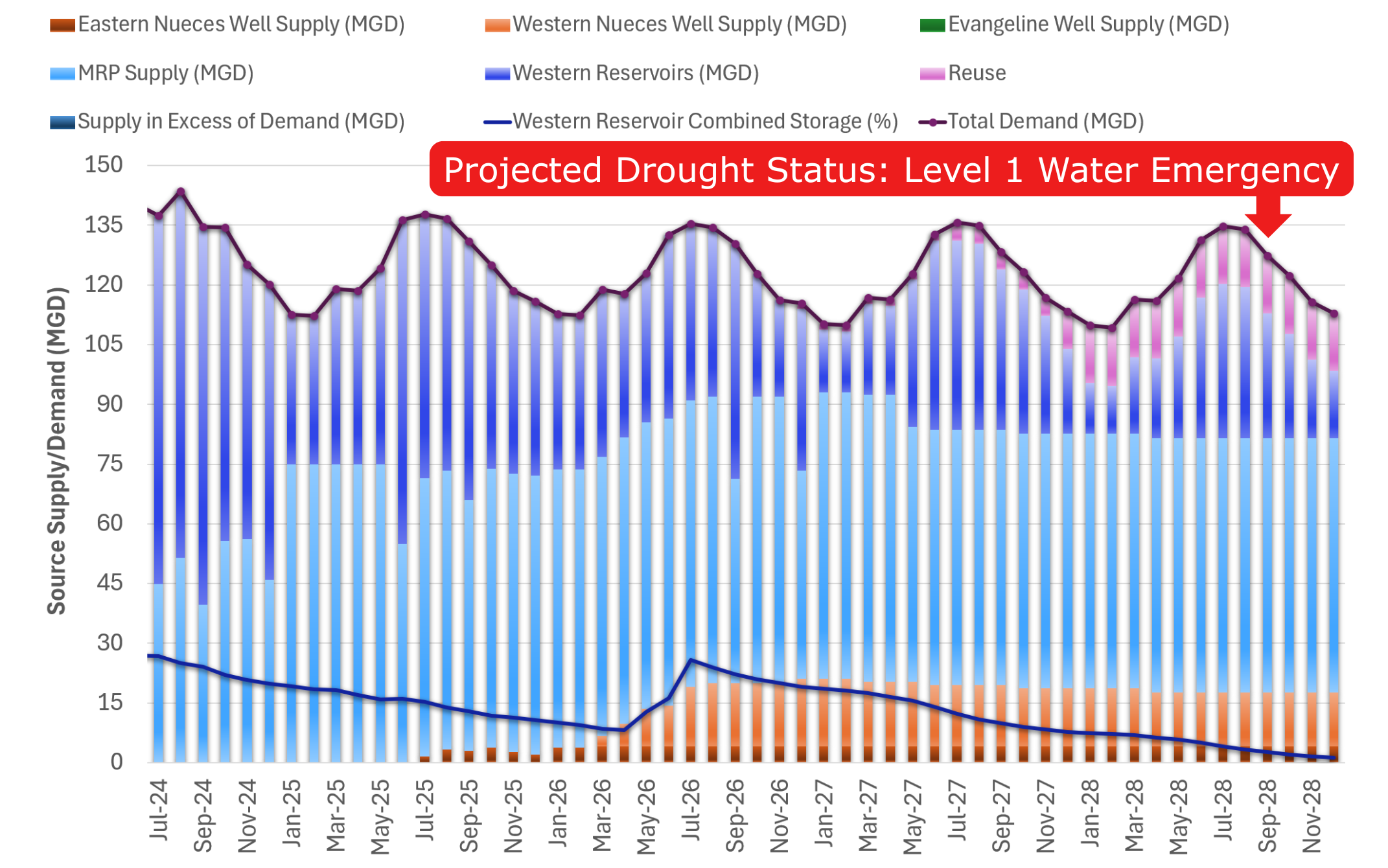
Model inputs and assumptions:
Western Reservoirs
- Inflows as of July 26, 2026, were utilized
Nueces Groundwater Program
- Continue to operate per the protocols and monitoring plan established in the TCEQ Bed and Banks permit
Reclaimed Water
- Reclaimed water to offset demand is estimated to begin in December 2026, with amounts increasing through 2027
Wholesale Customers - Alice, Mathis, and Beeville
- Demand reduction due to new water supply projects
Mary Rhodes Pipeline
- Operating at Schedule 4 (72 MGD), typically except for:
- Two-day shutdown of Mary Rhodes Pipeline for LNRA maintenance
- Four Weeks Operation at Schedule 3 (55 MGD) to accommodate upgrades at the Woodsboro Pump Station
- Three Weeks operating at Schedule 2 (43 MGD) to accommodate upgrades at the Bloomington Pump Station
Our Water Supplies
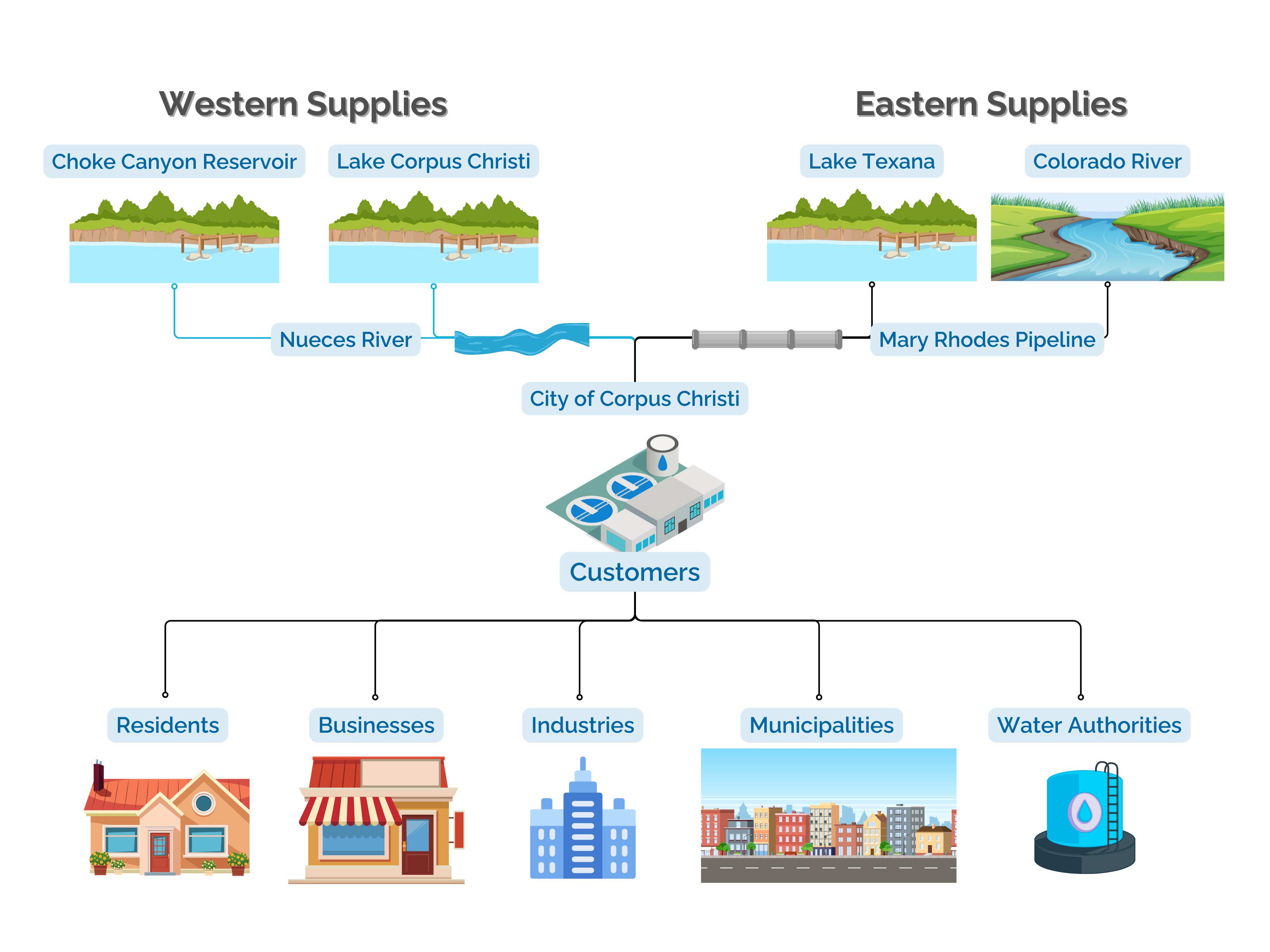
CCW supplies water for municipal and industrial use in a seven-county service area covering 140 square miles. From the west of Corpus Christi, water is drawn from the Lake Corpus Christi and Choke Canyon Reservoir System, both within the Nueces River Basin, and sent to the O.N. Stevens Water Treatment Plant. To the east of Corpus Christi, water is transferred from the Colorado River via Mary Rhodes Pipeline Phase II and from Lake Texana via the Mary Rhodes Pipeline Phase I and sent to the O.N. Stevens Water Treatment Plant.
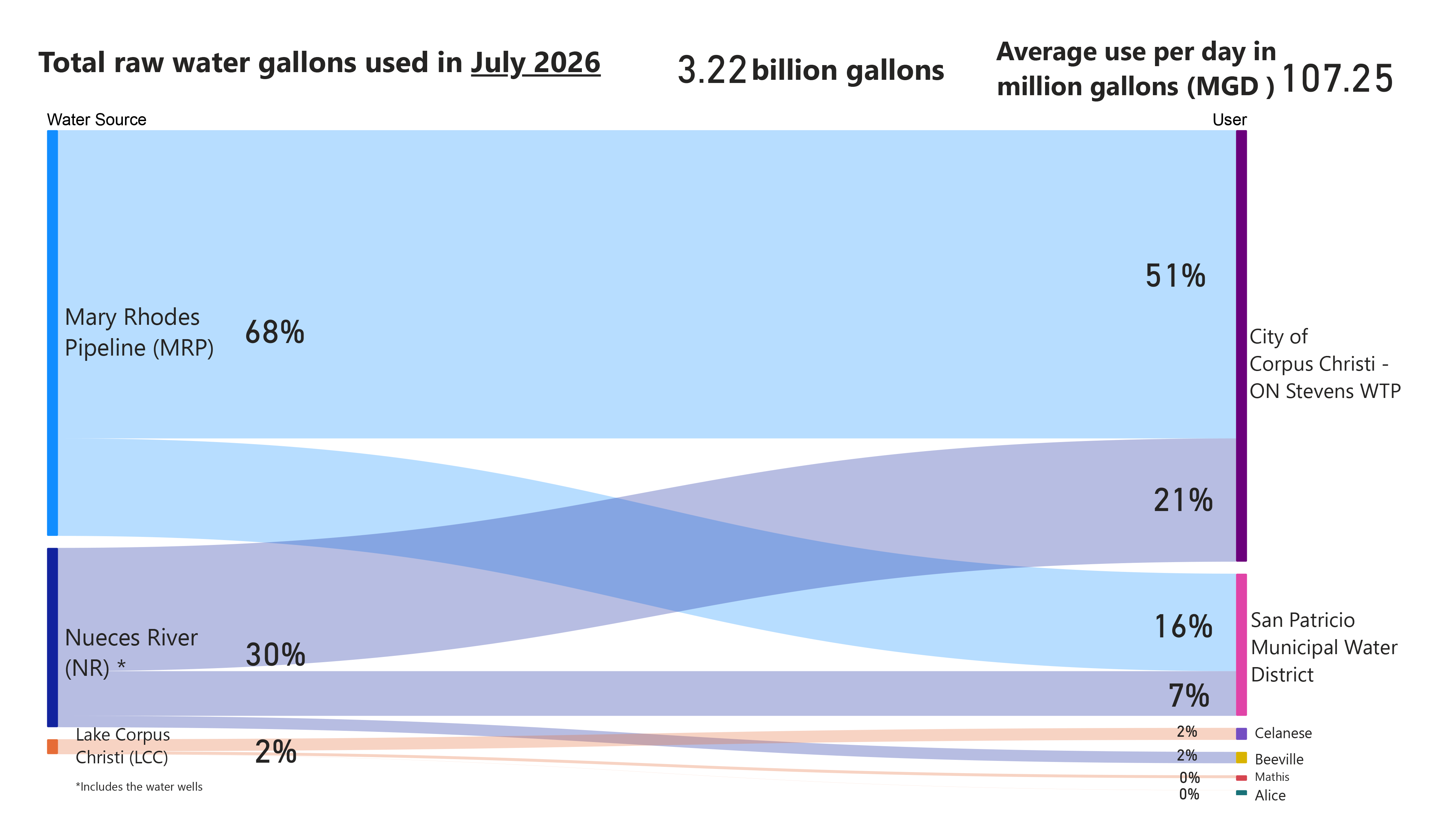
Monthly Raw Water Usage
Monthly summary of how our water sources are used. This graphic will be updated monthly. View PDF version.
Choke Canyon Reservoir and Lake Corpus Christi are the City’s longest-established and largest water supplies. The City controls the water in both reservoirs. Both reservoirs are monitored daily and are operated per the 2001 Texas Commission on Environmental Quality (TCEQ) Agreed Order. The 2001 Agreed Order is an agreement between the State and the City that mandates that the combined reservoir storage level be used to implement drought stages. For these reasons, the City uses the combined capacity of Choke Canyon Reservoir and Lake Corpus Christi as the triggering criteria for the initiation of the drought stages as described in our Drought Contingency Plan, this also ensures the protection of our largest water supplies.
Level 1 Water Emergency*
Pursuant to the 2025 approved Drought Contingency Plan, the City has adopted a new “Level 1 Water Emergency” previously known as “Stage 4”. This Level 1 Emergency is initiated when the City reaches 180-days from when the total water supply is not enough to meet the total water demand. This does not mean the City has run out of water as millions of gallons are still available from the Eastern Supplies (i.e., Lake Texana and the Colorado River).


About Us
Our mission is to provide the highest quality water and wastewater services that exceeds regulatory requirements and serves the region. We do this by upholding the highest standards, providing innovative solutions, leading strategic initiatives, and prioritizing continuous improvement. Corpus Christi Water also oversees wastewater management services and the Utility Billing Office.
Contact Information
 Pay Your Utility Bill
 Call 3-1-1
 View the 3-1-1 Portal
Mailing Address
2726 Holly Road
Corpus Christi, TX 78415